


These all sound great to me and the color's work for the July 4th Holiday this weekend so lumping them together as one file download which seemed to catch on this week. The Sugar Blues is a classic standard and should be heard. Supplemental to the saxophone records is the below post for Charles "Bird" Parker the most famous saxophone innovators from the early daze. Discogs had most but not the [White] album artists Philip and Smellie. Ha Ha what a name but make great free form sounds.
https://bestfile.io/en/P2TdVgFe2AdOGBF/file
Here is the Discogs info: Phil Bodner is probably better known among jazz fans for his clarinet work, but the sax was definitely in his toolkit as well, particularly when he was primarily a studio musician.
Bodner had spent a lot of time backing other musicians and vocalists when this one-off solo LP was released in 1962. The short orchestral arrangements of jazz and pop standards were definitely designed for easy listening airplay.
Later in the '60s and into the following decade, Bodner was the leader of The Brass Ring, a studio group whose light instrumental pop recordings were a staple of easy listening radio.
Clyde McCoy Profile: American jazz trumpeter, bandleader, and co-founder of Down Beat magazine.
Born December 29, 1903 in Ashland, KY, USA.
Died June 11, 1990 (age of 86) in Memphis, TN, USA.
Married to Maxine Bennett (1945-1990, his death).
As a musician, best remembered for his theme song, "Sugar Blues", written by Clarence Williams and Lucy Fletcher.
Real Name: Leroy Anderson
Profile: American composer of short, light concert pieces (June 29, 1908, Cambridge, MA – May 18, 1975, Woodbury, CT).
Anderson was born to Swedish immigrants in Massachusetts, where he studied piano at the New England Conservatory of Music and in 1925, he entered Harvard University. At Harvard he studied theory with Walter Spalding, counterpoint with Edward Ballantine, harmony with George Enescu, composition with Walter Piston and double bass with Gaston Dufresne. He also studied organ with Henry Gideon.
Anderson continued his graduate studies at Harvard and became the Director of the Harvard University Band. He wrote a number of catchy arrangements that eventually caught the ear of Arthur Fiedler. He made his first arrangement for Fiedler in 1936, and in 1938, The Boston Pops Orchestra performed his piece, Jazz Pizzicato. At Fielder's request, Anderson wrote the companion, Jazz Legato, in 1939.
In 1942 Leroy Anderson joined the U.S. Army. During his time in the armed forces, he wrote The Syncopated Clock and Promenade. In 1951, he was recalled for active duty for Korean War and wrote his first hit Blue Tango. Throughout the 1950s and 1960s, Anderson wrote many more of his "miniature" pieces, most of which were first performed and recorded by Arthur Fiedler And The Boston Pops. His pieces, including Sleigh Ride, The Typewriter, Bugler's Holiday, and A Trumpeter's Lullaby are still performed by orchestras and bands ranging from school groups to professional organizations.
For his contribution to the recording industry, Leroy Anderson has a star on the Hollywood Walk of Fame at 1620 Vine Street. He was posthumously inducted into the Songwriters Hall of Fame in 1988. In 1995 the Harvard University Band's new headquarters was named the Anderson Band Center in honor of Leroy Anderson.


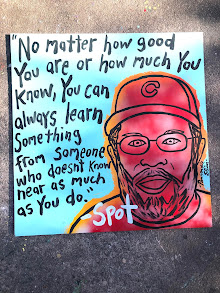
![For Gary Floyd [R.I.P]](https://blogger.googleusercontent.com/img/a/AVvXsEg3Sk-WjHtSlwrOvH6SfkdkPv9mmdDZ7nfqhcJoeQge_Lx7NxTgfx54yjQ7e84EjVTRypFn_OHTBKfeLN8YXTkK8AXcYeiMY0cDgrVYMg_XE5_u0bDkr1pCOZ23Q-7MuamgUX_Kxorudt3KdJG0GMk5L-lJgIK1QxKGJ4zAQeipLq9RG34-0s81CCoN3YE=s289)




 Join the Blue Ribbon Online Free Speech Campaign!
 Posts
Posts


No comments:
Post a Comment